
Northern Nevada gardens and backyards: Those funny holes are from big striped beetles
 Some folks call them “June bugs,” but they are actually a beetle rather than a true bug.
” data-medium-file=”https://i0.wp.com/www.carsonnow.org/wp-content/uploads/2025/07/7-17-25-june-beetle-holes.jpg?fit=300%2C284&ssl=1″ data-large-file=”https://i0.wp.com/www.carsonnow.org/wp-content/uploads/2025/07/7-17-25-june-beetle-holes.jpg?fit=502%2C475&ssl=1″ />
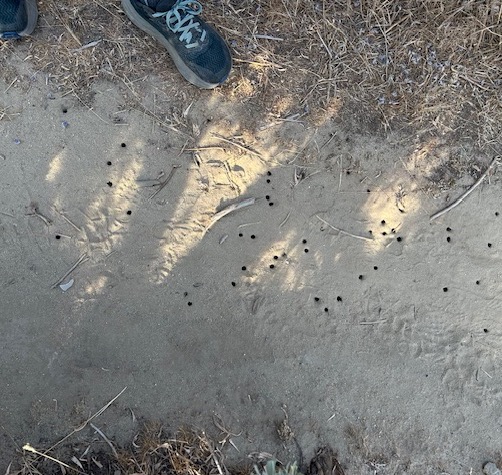
By JoAnne Skelly — What are these funny holes in the ground someone recently asked Jeff Knight, the state entomologist with Nevada Department of Agriculture? They have straight sides and look as if they were made with a walking stick. Knight thought they were either cicada exit holes or June beetle holes.
” data-medium-file=”https://i0.wp.com/www.carsonnow.org/wp-content/uploads/2019/02/102954-jskelly.jpg?fit=141%2C175&ssl=1″ data-large-file=”https://i0.wp.com/www.carsonnow.org/wp-content/uploads/2019/02/102954-jskelly.jpg?fit=141%2C175&ssl=1″ src=”https://i0.wp.com/www.carsonnow.org/wp-content/uploads/2019/02/102954-jskelly.jpg?resize=141%2C175&ssl=1″ alt=”” class=”wp-image-113846″ style=”width:147px;height:auto” srcset=”https://i0.wp.com/www.carsonnow.org/wp-content/uploads/2019/02/102954-jskelly.jpg?w=141&ssl=1 141w, https://i0.wp.com/www.carsonnow.org/wp-content/uploads/2019/02/102954-jskelly.jpg?w=370&ssl=1 370w, https://i0.wp.com/www.carsonnow.org/wp-content/uploads/2019/02/102954-jskelly.jpg?w=400&ssl=1 400w” sizes=”(max-width: 141px) 100vw, 141px” />
When my husband reported also seeing similar holes in our walkway, I realized I have been seeing dead 10-lined June beetles on the patio recently. Some folks call them “June bugs,” but they are actually a beetle rather than a true bug. True bugs have piercing-sucking mouthparts and beetles chew.
A cool fact is that June beetles are relatives of scarab beetles, which are famous in Egypt. The 10-lined June beetles are about one inch long, brown with white lines on their backs. They are active after dusk and often fly near lights at night. Because they are clumsy fliers, they may hit windows and screens, which is what I suspect happened to the dead insects on my patio.
After mating, the females burrow into soil, particularly sandy soil, to lay eggs, which then develop into large white grubs. The white grubs with brownish heads can be 2 inches long. The grubs feed on the roots of trees, shrubs, perennials and grass. In large infestations, they can severely damage fruit trees.
After a couple of years in the soil, the larvae pupate in the soil through the fall and emerge as adults the following spring into summer, often in June, hence the name. They then fly through August and September.
The adults do little damage to plants, just a bit of notching to the edges of leaves. In most urban landscapes, grub damage doesn’t require control, which is a good thing, because control of grubs is quite challenging.
It can require removing infested trees in an orchard for example. There are no effective methods to move insecticides down into the soil, often more than 8 inches, to kill the second and third stage grubs. While there are natural enemies that can parasitize the grubs, their impact is minimal on reducing populations. I have often seen a few adults at this time of year but have never seen any grub damage.
The 10-lined beetle can hiss loudly when disturbed and males may spread and fan their wings potentially frightening someone. However, they are harmless.
If you find grubs, feed them to your chickens!
Go here for more information.
— JoAnne Skelly is Associate Professor & Extension Educator, Emerita at University of Nevada Cooperative Extension skellyj@unr.edu.
The post Northern Nevada gardens and backyards: Those funny holes are from big striped beetles appeared first on Carson Now.